
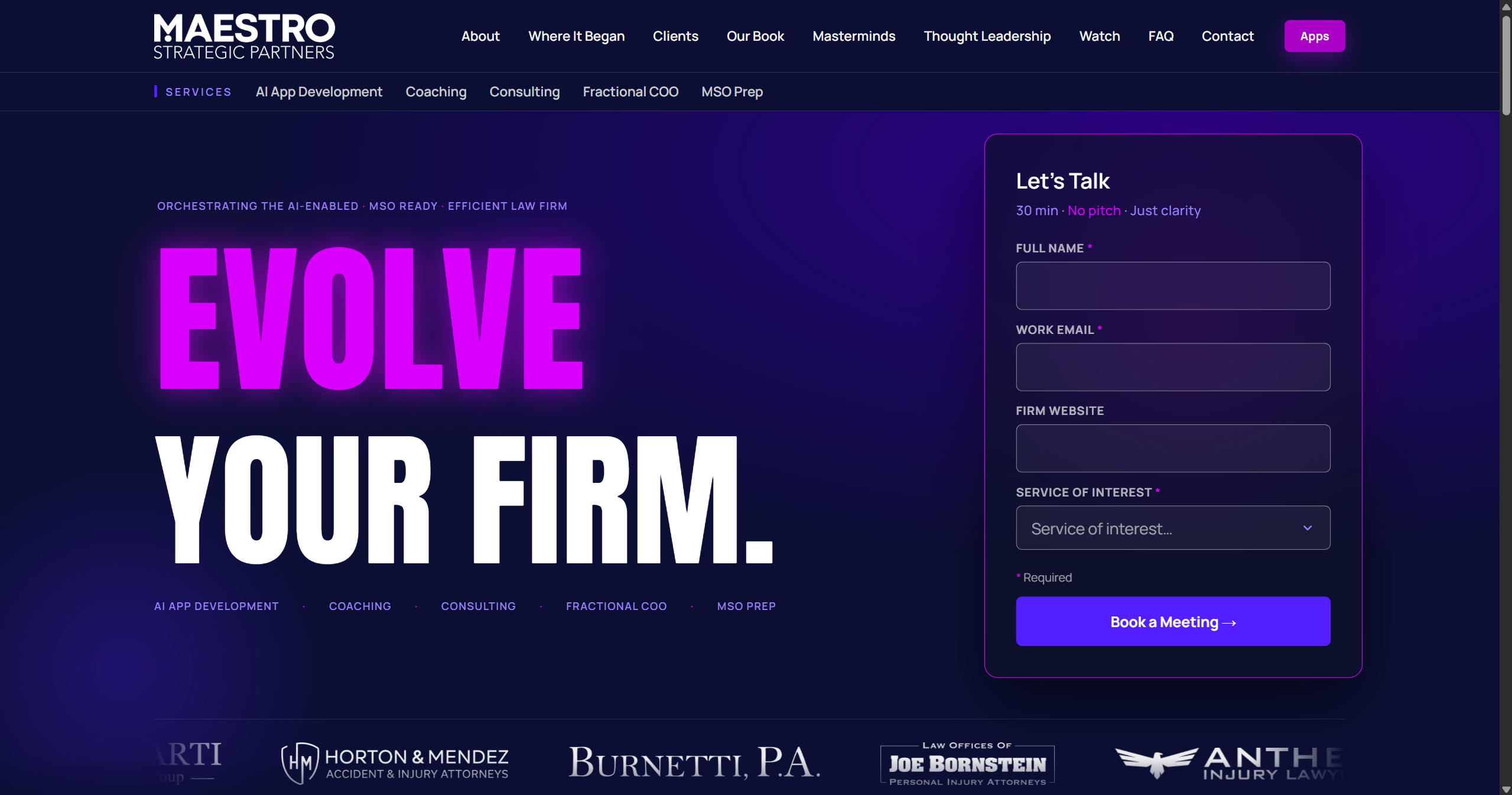
This site was built entirely with AI. It’s no longer a hypothetical case study for us, nor a client anecdote. It’s the page under your cursor.
Why We Did This Ourselves
We spend a lot of time helping law firms evolve. It’s easy to forget that the same pressure applies to us. We’re operating in the middle of a technology shift moving faster than most organizations can absorb, and the only way to have a credible opinion about that shift is to live inside it.
So we’ve been running experiments on ourselves. This site is one of them.
How It Started
Not with a strategy deck. With a favor.
An attorney friend of ours needed help with developing his website. We said yes, and then we were in it — reading documentation, breaking things, fixing them, breaking them differently, learning what a build pipeline does and why a page loads slowly and what to do about it.
Somewhere in there, the favor became an education.
To be clear: we were genuinely happy with our former web vendor. They did good work. This was never about dissatisfaction. It was about discovering, mid-project, that we had accidentally acquired a capability we didn’t have before — and deciding we should use it.
What AI Actually Did Here
The honest version is more nuanced than “AI built this site.”
AI collapsed the distance between having an idea and seeing it rendered. Where we would previously have written a brief, waited, reviewed a mockup, sent notes, and waited again, we could describe something and evaluate it in minutes. When iteration is nearly frictionless and immediate, you iterate more — and you make better decisions, because you’re reacting to something real instead of imagining it.
It also flattened the learning curve. Web development has an enormous surface area of conventions that practitioners know and nobody writes down. AI let us ask without embarrassment, immediately, repeatedly, until the concepts stuck. DNS records alone — CNAME, A, TXT, MX — are a reminder that web development is a lot more complicated than it may initially appear.
What it didn’t do was make judgment calls. It didn’t decide what this page should say, who it’s for, what you should feel in the first five seconds, or which of three plausible layouts was right. Those stayed our problems.
The tool removed execution friction. It did not remove the requirement to know what you’re building.
The design, look-and-feel — those remained personal and, frankly, took the most time. What and how to say it, what should be held onsite (e.g. patents) versus what could be referenced (e.g. videos), the strategy for deploying content — all of that was judgment, not execution.
The Parts That Didn’t Go Smoothly
The useful version includes the friction.
Early velocity is deceptive. The first eighty percent arrives fast enough to make you overconfident. The last twenty — edge cases, mobile breakpoints, the small inconsistencies between finished and nearly finished — takes proportionally much longer.
You have to be able to evaluate the output. AI will confidently produce something that looks right and isn’t. If you can’t assess quality, you can’t catch it. Which is exactly why the learning was the point, and why “AI means you don’t need expertise” is the wrong lesson. Expertise just gets deployed differently.
Coherence needs a human holding the thread. Individual pieces can each be good while the whole thing drifts.
This Is Step One
This site isn’t the destination. It’s infrastructure.
We have AI applications coming, and they need somewhere to live — a platform, not a brochure. What you’re on today is the first of several steps toward a site that doesn’t just describe what we do but delivers it.
Building it ourselves was partly capability, partly control. When your site becomes the delivery mechanism for your product, you want to understand it at a level that doesn’t require a ticket and a two-week turnaround. We can now build what we need cheaper, faster, and bespoke.
Now Tell Us What’s Wrong With It
Here’s the actual ask.
Keep clicking. Notice what’s confusing, what’s slow, what doesn’t make sense, what you expected to find and couldn’t. Then tell us — bluntly is fine. Bluntly is better. Use a contact form and let us know (that way we test the forms AND get the feedback).
We shipped this knowing it isn’t finished, because nothing is, and because the alternative is polishing indefinitely and learning nothing.
The only way to evolve is to iterate and implement.