
$1.1 BillionTo the Farmers.
A $1.25 billion settlement is a number on paper until it finds more than 18,000 farmers scattered across the country. This is the public record of how it did.
For decades the United States Department of Agriculture denied Black farmers the loans and disaster relief it extended to their white neighbors, and then denied them the complaint process meant to catch it. Farms were lost. Pigford v. Glickman and Brewington v. Glickman settled the first wave in 1999 — at the time, the largest civil rights settlement in history. But roughly 22,700 farmers filed by the deadline while about 61,000 more asked to file late. Fewer than 3,000 of them could show the “extraordinary circumstances” the consent decree demanded. More than 58,000 never had their discrimination claims heard at all.
In re Black Farmers Discrimination Litigation — the Consolidated Case, also called Pigford II — was the case for those 58,000. The 2008 Farm Bill gave them a new right to sue, but funded it with only $100 million, which was never going to cover valid claims. The February 2010 settlement agreement was contingent on Congress finding the rest. It ended in a $1.25 billion settlement — one of the largest civil-rights class actions in American history. The court appointed 21 law firms as Class Counsel to get there. One of them was the Law Offices of James Scott Farrin, of Durham, North Carolina.
The Part That Isn’t in the Headline
Winning the settlement was not the same as delivering it. A farmer who cannot reach a meeting does not file a claim, and a claim not filed is a farmer who gets nothing — whatever the headline number says. Pigford had shown exactly how that fails: claimants criticized the communication, the choice of venues, the wait times, and the thin staffing of attorneys to help with the forms. Class Counsel concluded this process would need many more meetings in more locations, considerably more lawyers and paralegals, and planning of real intricacy. The problem was logistics, and logistics was the difference between a settlement and a remedy.
What Was Built
Eric Sanchez was, in his sworn words to the court, “the person primarily responsible for setting up and overseeing the claims process in the case,” and Class Counsel’s point person on data analysis, technology and client communication. Roughly 89,000 claim forms went out. He examined the longitude and latitude of claimants’ last known residential addresses against proposed meeting locations, and solved for distance — scheduling at least one meeting within 75 miles of the last known address of more than 97% of claimants. Then he ran it: 384 group meetings in 66 cities across 23 states and the District of Columbia, which put counsel in front of nearly 22,000 claimants in person.
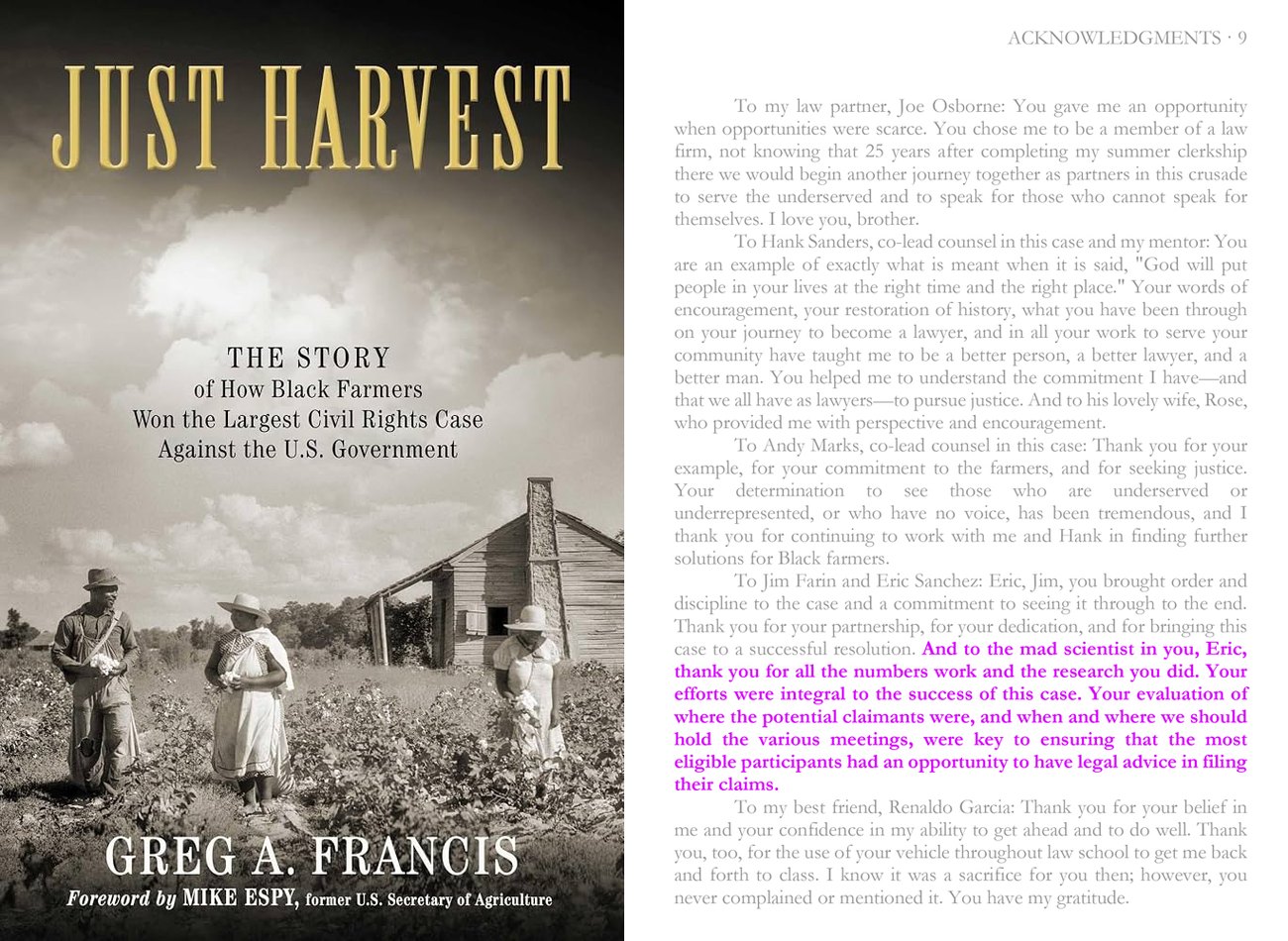
“And to the mad scientist in you, Eric, thank you for all the numbers work and the research you did. Your efforts were integral to the success of this case. Your evaluation of where the potential claimants were, and when and where we should hold the various meetings, were key to ensuring that the most eligible participants had an opportunity to have legal advice in filing their claims.”
Congress Had to Fund It
A settlement against the United States is not payable until Congress funds it. The Claims Resolution Act of 2010 — Pub. L. 111-291 — provided the $1.15 billion that, on top of the Farm Bill’s $100 million, brought the total to $1.25 billion. President Obama signed it on December 8, 2010. Eric was in the room. Judge Paul L. Friedman approved the settlement on October 27, 2011, resolving the 23 lawsuits consolidated into the case.
Then the Court Weighed the Work
The government opposed Class Counsel’s fee request, asserting the case was not “particularly unique, novel, or complex, and that there was very little original work to perform.” Eric answered it on November 26, 2012 with a sworn declaration setting out what the claims process had actually taken — the synchronized databases, the portable scanners and hotspots, the surge plan that ran several days of meetings in five locations at once in the final week. He attested that the case “required an immense amount of unique work of extraordinary complexity,” and that if it looked routine to the government in retrospect, that was either unfamiliarity — they took no part in it — or a testament to planning that averted the problems. Judge Paul L. Friedman awarded the fees in the full amount requested — 7.4% of the common fund, $90,835,000, the maximum the Settlement Agreement allowed. The declaration, the government’s opposition and the court’s opinion are all on the public docket.
“…the most important part in closing this case successfully.”
The Man Who Rode a Mule to Washington
John Boyd Jr. founded the National Black Farmers Association. For years he rode a mule and wagon from his farm to Washington, D.C. to make the country look at what was happening to Black farmers. He had a lot of lawyers on this case, and a lot of people traveling with him. In 2014 he presented the association’s Recognition of Excellence Award to Eric.
He was specific about why.
“Although I traveled with many of you, it was Eric that I was talking to every day about the problems… a team needs a quarterback, and needs somebody on the sideline that can even whisper the play.”
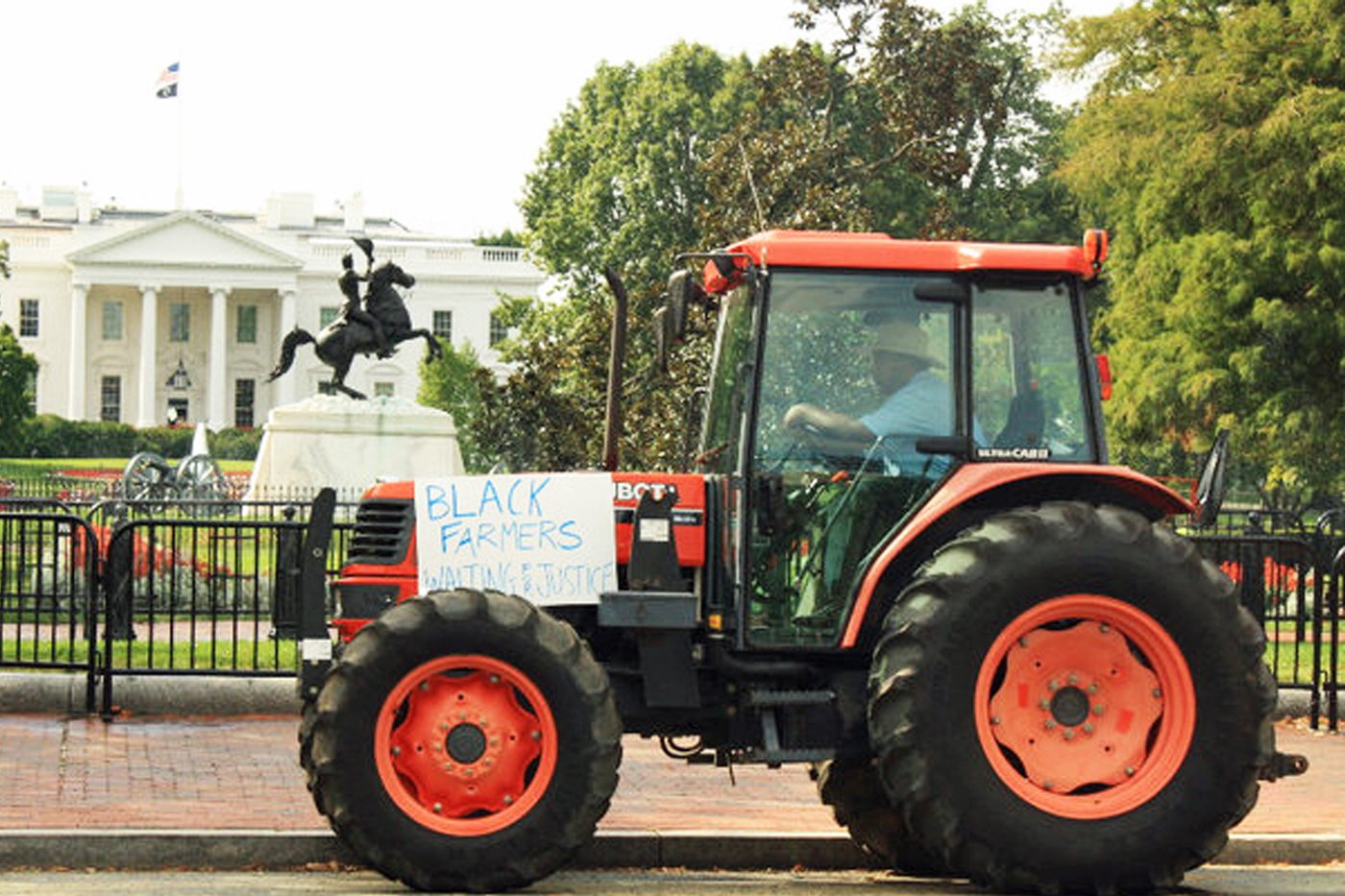
And then he gave away the thing he is famous for. The tractor that sat in Washington for months — Justice — keeping the Black farmers’ claims in front of the country: that was Eric’s idea. Boyd said he told him it would work, if Eric could find him a tractor that would make it there.
Why It’s on This Site
Not as a trophy. The $1.1 billion belongs to the farmers who spent thirty years being told to wait. Twenty-one firms were Class Counsel; the lawyering was theirs. It is here because the claims process was ours to build, and it is the clearest evidence of what we actually do: take the operational problem that decides whether people are served or not, and solve it at scale, under a deadline, with the record open to inspection afterwards. Eric’s full background · where it began.
The Record.
The court filings, the federal statute and the claims administrator’s own records.
Let’s Talk.
30 minutes. No pitch. Just a clear look at what’s getting in your way.
30 min · No pitch · Just clarity